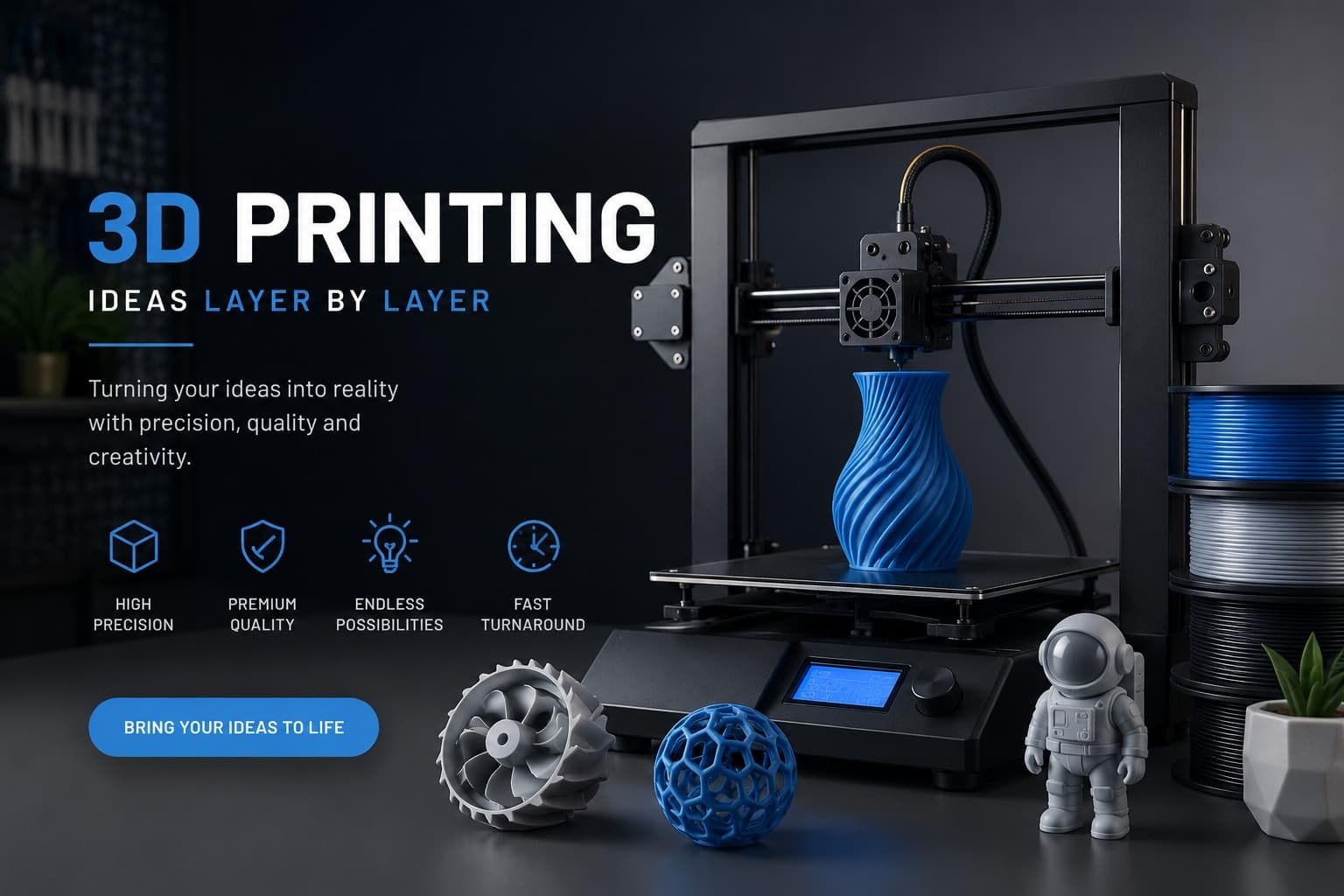
Carbon-Fibre 3D Printing Services UK
Motorsport-grade polymers · ±0.2 mm tolerance · Prototypes in 2–4 days
Key Benefits
Mechanical Performance
Lightweight and durable mechanical components, resistant to temperatures up to 200 °C.
Rapid Turnaround
High-accuracy prototypes delivered in 2–4 working days. Short production runs completed within 5–10 days.
Surface Finish
Improved surface quality and reduced layer lines; smoother finishes achievable on select machines, with primer-ready options available.
Our 3D Printing Process
Instant Quotation & Design Review
- Upload your CAD or STL files and receive a quote within 1 business day.
- Our engineers review wall thicknesses, overhangs and assembly fits to ensure manufacturability.
Material & Machine Selection
We select the optimal material and printing technology based on your requirements for strength, temperature resistance, and surface finish.
Build & Monitor
Your parts are printed with precision monitoring throughout the build process to ensure quality and accuracy.
Post Processing & Quality Inspection
Final finishing, support removal, and thorough quality inspection before dispatch.
Typical Industries & Applications
Motorsport
Mounting brackets, aerodynamic fins, intake manifolds
Automotive
Custom fixtures, dash panels, tooling
Industrial
End-use housing, pump components, handles
Frequently Asked Questions
What is the maximum build size for 3D printing?
Up to 325 × 320 × 325 mm (x, y, z) on our largest printer.
Can you print multiple parts in one build?
Yes — our machines allow us to batch as many parts as fit on the print bed in a single run.
What materials do you offer for 3D printing?
We print in PLA, PETG, ASA, PC and ABS, as well as carbon-fibre-reinforced composites including PLA-CF, PETG-CF, PA6-CF, and PAHT-CF.
What tolerances and layer resolutions can you achieve?
Standard tolerances are ±0.2 mm. Layer resolution goes as fine as 50 µm.
How long does a typical 3D printing job take?
Rapid prototypes: 1–2 working days from file upload to dispatch. Short production runs (10–50 pcs): 5–10 working days.
Can I upload my own CAD or STL files?
Yes. We accept STL, OBJ, STEP, and IGES formats.
How is pricing calculated for 3D printing?
Pricing is based on material, volume and machine time. Simple parts below 50 cm³ often qualify for fixed-rate quotes from £25.
Get a Quote for 3D Printing
Ready to start your project? Contact us and receive a quote within 1 business day.
Get a Quote