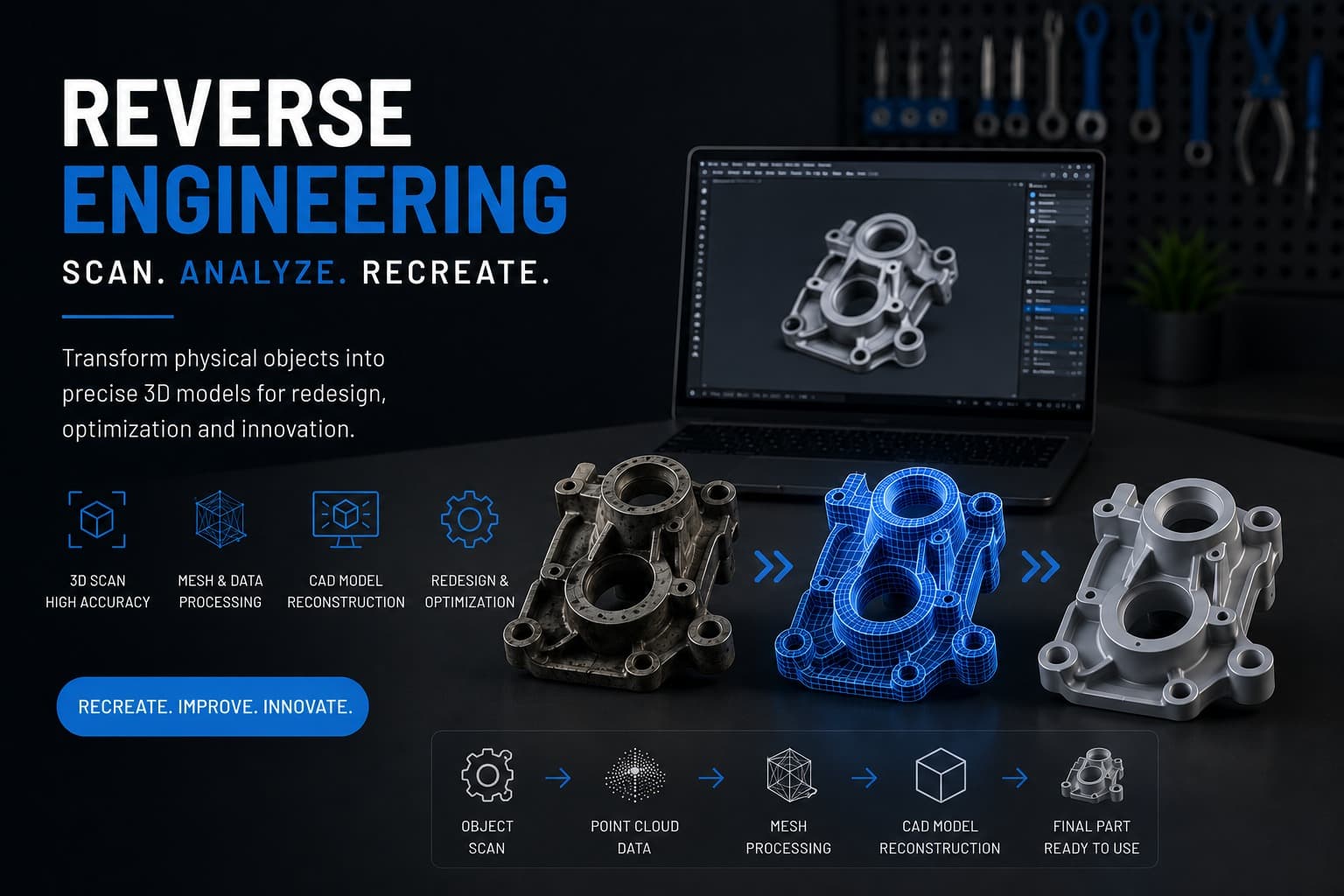
Reverse Engineering Services UK
3D scan to CAD reconstruction · ±0.03–0.05 mm accuracy · STEP & IGES deliverables
Why Reverse Engineer?
Legacy Parts Reproduction
Many critical components — especially those used in aerospace, automotive, or industrial machinery — are no longer in production. Reverse engineering lets you recreate these parts exactly, restoring functionality without needing original drawings.
Tooling & Fixture Design
By capturing an existing part's exact geometry, you can design jigs, fixtures, or moulds that fit perfectly, speeding up setup times and ensuring repeatable accuracy.
Spare-Parts Manufacture
Small batches of specialised parts — custom fasteners, machined brackets — become cost-effective when you can scan and then print or machine them on demand.
Our Reverse Engineering Process
High-Precision 3D Scan
Point-Cloud & Mesh Optimisation
Surface-and Solid-Model CAD Recreation
Dimensional Verification
Deliverables & File Formats
Optimised Mesh
.STL, .OBJ
Editable CAD Model
STEP, IGES
Inspection Report
PDF with colour-map overlays and dimensional tables
2D Drawings (optional)
PDF, DWG
All files delivered via secure download link within agreed turnaround times.
Typical Industries & Applications
Automotive & Motorsport
Prototype components, tooling jigs, crash parts
Heritage & Conservation
Precision-faithful CAD for restoration projects
Industrial Machinery
Spare parts replacement, custom machine components
Medical Devices
Reverse engineering of organic surfaces/structures
Electronics
Battery covers, enclosures, custom components
Frequently Asked Questions
What is reverse engineering?
Reverse engineering is the process of turning a physical part into a fully editable CAD model by capturing its geometry via 3D scan, then cleaning and reconstructing the mesh.
How does your reverse engineering service work?
We capture your part with ±0.03–0.05 mm accuracy, process the point cloud into a watertight mesh, then rebuild surfaces as parametric solids in STEP or IGES.
What part sizes can you reverse engineer?
We handle everything from small precision parts under 50 mm to large assemblies several metres in size.
How long does a reverse engineering project take?
Simple parts: 7–10 working days. Complex or large assemblies: 15–20 working days. Rush services available.
What deliverables and file formats do you provide?
Editable CAD models (STEP, IGES), optimised mesh (STL, OBJ), inspection reports (PDF), and optional 2D drawings (DWG or PDF).
Can you modify or optimise the design during reverse engineering?
Yes. Our CAD recreation process can incorporate design improvements, wall-thickness adjustments, weight reduction features or added mounting points, and we document any changes with revision history for full traceability.
Do you sign NDAs or confidentiality agreements?
Yes. 3D Reverse will sign your NDA or work under our standard confidentiality agreement to keep your IP fully protected.
Get a Quote
Ready to start your reverse engineering project? Contact us to discuss your requirements.
Get a Quote