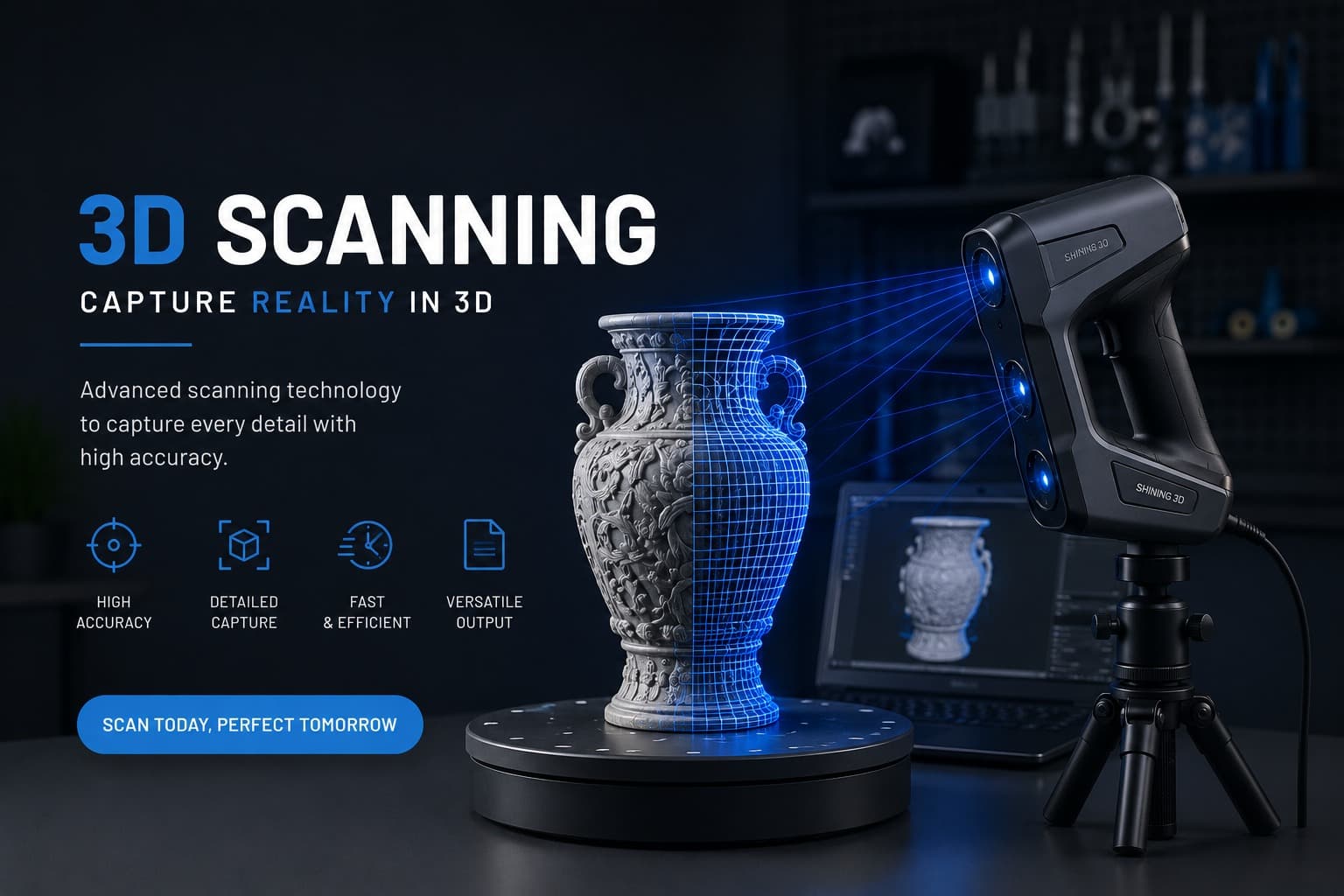
3D Scanning Services

High-precision 3D scanning of components

At 3D Reverse, we offer high-precision 3D scanning to capture complex shapes with ease. Our contact-free system handles both small details and large parts, with typical accuracy between ±0.03–0.05 mm.

It adapts to different surfaces, sizes, and finishes — perfect for reverse engineering, quality control, or digital replication.

High-precision 3D scanning of components

Frequently Asked Questions

How long does a typical 3D scanning project take?

Simple parts (< 1 m² surface) are scanned, processed and delivered within 1–2 weeks. Large or highly detailed assemblies typically require 3–4 weeks.

Which file formats can I receive?

We deliver raw point clouds (.PLY), meshes (.STL, .OBJ) and parametric CAD models (STEP, IGES)

What resolution and accuracy can I expect?

We routinely achieve ±0.03–0.05 mm accuracy, with point spacing as fine as 0.02 mm for detailed components.

Do you handle large or fixed objects?

Yes — our portable structured-light and photogrammetry systems can scan large objects up to 3 metres, including in-situ equipment and fixed installations.

Can you scan reflective or transparent surfaces?

Yes—although these materials can pose challenges, we use temporary matt-spray coatings or special scanning modes to capture accurate data on shiny, glass or clear plastics without compromising final part quality.

How do you ensure data security and confidentiality?

All scan data is transferred via secure, encrypted links and stored on GDPR-compliant servers. We're happy to sign NDAs or comply with your corporate security policies to keep your IP safe.

Our 3D Scanning Workflow

1

Object Preparation

2

Surface Scanning

3

Capturing the Digital Mesh

4

Refining and Cleaning the Geometry

5

Usable CAD File

Deliverables & File Formats

Raw Point Cloud: .PLY

Optimised Mesh: .STL, .OBJ

Parametric CAD: STEP, IGES

Inspection Report (optional): Comparison to original CAD or measured specifications

All files are quality-checked and delivered via a secure download link.

Typical Industries & Applications

3D scan of an organic artifact for heritage preservation and conservation purposes

Heritage & Conservation:

Digital archiving of sculptures, architectural elements

3D scanning for dimensional inspection and quality control of precision-engineered components

Quality Control:

Inspecting initial prototypes, checking part tolerances, and validating batch samples.

3D scanning of a worn mechanical component for reverse engineering and part reproduction

Reverse Engineering:

Recreating legacy parts, designing custom tooling, and producing replacement components.

3D scanned wheel hub component for automotive and motorsport applications

Automotive & Motorsport:

Mounting brackets, aerodynamic ducts, supports, and prototype test parts.

Contact Us

Ready to start your 3D scanning project? Get in touch for a quote.

Contact Us
WhatsApp